
Overview
You’ve been in that meeting. The one you entered with ideas, optimism, and engagement. But after hours (or days!) you exited feeling demoralized and disengaged, wondering if anything was accomplished or worse, if you should leave the team or organization.
It’s the meeting where the loudest voice won — not the best idea. Where laptops never closed, and you watched the extraction of souls with death by power point. Or where it was clear all attendees were there simply to sign off on the boss’ ideas. The group left with less clarity than when they walked in. No real outcome emerged. No decisions were taken. No ownership assigned. No clarity on next steps.
The room held captive some of the smartest people in the organization. Yet despite all the intelligence, experience, and authority, no progress was made.
That gap — between the intelligence in the room and the outcomes that actually emerge — is the Facilitation Gap. And the debilitating expanse of its costs are profound.
Most people think facilitation is running meetings. But facilitation is the systematic creation of movement through the contributions of others. It’s the ability to help a group move from confusion to clarity, from abstractions to concrete ideas, from friction to alignment, and from discussion to decision.
The good news is, these outcomes are highly replicable because great facilitation is systematic — a set of tools, frameworks, and techniques that, when employed with mastery and intention, consistently produce the clarity, engagement, and action necessary to propel a team toward the target.
This article is not comprehensive, but it will gives you a toolkit that I have found to be extremely effective and consistent in discovering the best ideas and creating movement in discoveries, workshops, and everyday meetings.
If you want to create change, big or small, and realize your potential, facilitation is an essential leadership skill you want in your arsenal.
The Facilitation Gap
Research consistently shows that poor meetings cost organizations billions in lost productivity every year. But the costs are much more profound than simply time spent in meetings. Lack of clarity, decision, commitment, and focus breed confusion. The ensuing chaos manifests in teams shipping work that fails to produce the targeted outcome, or worse, they ship nothing at all. Top talent disengages because the only thing they see clearly is that no matter what they do the game, as defined and played by decision makers, is not winnable.
This quagmire isn’t proof of the misguided axiom that ‘None of us is as dumb as all of us.’ It isn’t lack of collective intelligence; and it isn’t a product of groupthink, poor culture, or any other social phenomenon— at least not always (more on this in another post). Attendees are simply looking for a roadmap—how to get from where the collective conversation is to where it needs to go. They are looking for facilitation.
The impediment to the progress so desperately needed is that most leaders do not understand what skilled facilitation is. Their thought process is, get the best and brightest in a room together and they’ll figure it out. What seems like an embodiment of the admirable leadership quality of trust, is simply a cloak for detrimental ignorance.
However, when one is wise to it, this ignorance is on full display when the closest thing to a facilitator is the poor soul given the task (maybe even out of spite, as I don’t know why you would assign that task otherwise) to take notes in the awkward corner of the room, separated from any influence. Or when the experts who should be engaging in the conversation itself are asked to “lead the conversation,” in large part because they are the expert in the topic.
And then predictably, when the subject matter expert, due to a deficient skillset, fails to deliver the the desired outcome, the concept of facilitated conversation is abandoned altogether. Leadership returns to dictating rather than fostering… And the cycle continues.
For your career, a deficiency in facilitation is detrimental. Think about it. No one person achieves results in a vacuum. Michael Jordan needed Phil Jackson, Scottie Pippen, Horace Grant, John Paxson, and B.J. Armstrong. Your ability to deliver results depends on others.
You spend years developing your domain expertise — your technical knowledge, your strategic instincts. And then you walk into a room and expect your expertise to somehow organize itself into collective action. It doesn’t. Not without a structure. Not without someone who understands that a group of smart people does not guarantee a productive group.
The Facilitator Solution
You know when you’ve experienced great facilitation. You’ve felt it as you exited the venue, inspired and energized.
Whether in the classroom, boardroom, or any other room, where masterful facilitation is present engagement, decision-making, and learning improve and outcomes and alignment are achieved, but for the reasons you might think.
A facilitator isn’t the most knowledgeable or loudest in the room. In many cases, they speak less than everyone else. They’re not bulldozers, coercing alignment to predefined decision. They’re not a timekeeper with a slide deck.
A skilled facilitator is an architect— someone who designs the conditions in which a group can think, decide, and commit. They are as the conductor of the orchestra. Their job is not to play an instrument, but rather establish the tempo, flow, energy, and tonality of the composition. Said plainly, their job is not to be the talent. Their job is to unlock it.
There’s a well known Steve Jobs line. When asked, by his co-founder, Steve Wozniak, “You don’t code…. What is it that you do?” He replied, “I play the orchestra.” That’s facilitation.
The Facilitator Mindset
There are three principles that are foundational the facilitator mindset.
- Design before you convene. The outcome of a meeting is largely determined before the meeting begins. Clarity of purpose, sequencing of conversation, and the questions you bring to the room are the upstream variables that determine downstream results.
- Manage process, not content. This is the hardest shift for experts to make. When you’re the smartest person in the room on a subject, the instinct is to drive the answer. But facilitation requires you to drive the process — and trust the group to find its own answer, with your architecture supporting the journey.
- Hold the space, not the spotlight. One of the biggest mindset shifts in facilitation is understanding that the facilitator is not the hero of the room… The participants are. Many leaders feel pressure to have all the answers. To dominate the conversation. To prove value through expertise. But great facilitators and leaders understand alignment scales faster than control ever will and that their value is measured by what the group produces — not what they contributed. The best facilitators are often invisible in the transcript. Their fingerprints are on the outcome, not the record.
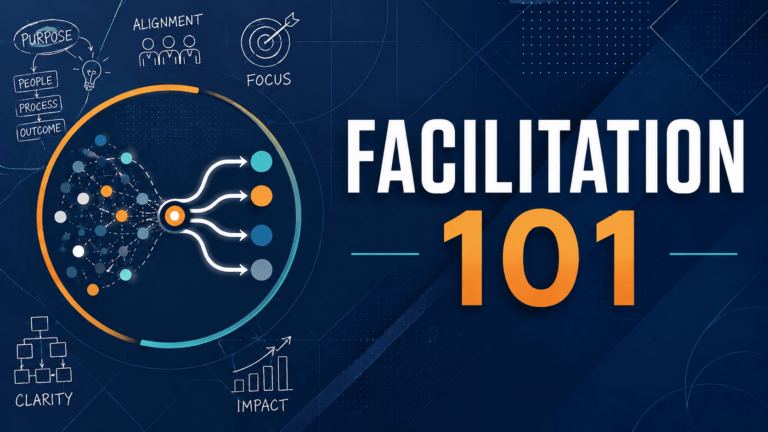
Facilitation 101
So what does facilitation look like in practice? Enter Rebecca Courtney from AJ&Smart. in this 8-min video you will learn ( to rip the introduction directly):
- What facilitation is
- What a facilitator does
- What makes a good facilitator
- What’s the value of facilitation
Facilitation in the AI Age
But wait… “Won’t these skills be obsolete with AI?”
I was asked this question recently in a conversation about Product Management. Its a valid question— one that everyone should be asking, as they look to stay ahead of the tsunami of transformations coming in the age of unmetered intelligence. But In short, the answer is, no—because facilitation is a leadership skill.
I will write in depth about why that is the case in a separate article, but will offer a few insights here.
AI will automate many of the facilitator’s tasks and will unlock new formats for workshops and meetings. But when the stakes are high and few expenses have been spared in large strategy sessions, facilitators will be more valuable than ever. Why?
AI can generate agendas. It can synthesize notes. It can surface data patterns. What it cannot do — what it will not do in any meaningful timeline — is read a room. It cannot feel the energy shift when a group is avoiding something. It cannot hold space with presence. It cannot ask the question that engages someone who’s been holding back for most of the meeting. It doesn’t know the participants and their relational dynamics, and so design and navigate an experience that extracts the best from the group.
Ironically, as technology becomes more advanced, deeply human skills become more valuable. Presence. Emotional intelligence. Adaptability. Listening. Judgment. Trust. That is what this next video is about.
Collaborative Problem Solving at Scale
Now that you know how the facilitator ads value, I want to share a TED Talk, by Tom Wujec, that reveals a surprising insight about how we collaborate, organize information, and solve problems. 9 min)
Steal this Workshop Template!
This next video is THE CORE of this post. The template provided here is what I used to create the kinds of experiences that we described above. It channels the concepts from the previous videos into an actionable toolkit that you can use immediately. You will want to copy this formula exactly, so get your note taking tool ready. You might also grab your energy stimulant of choice, as this is also the longest video in this point (1 hr).
Executing the Workshop: Start Strong, End Stronger
In under 10 minutes, this next video will take you from beginner to professional facilitator, giving you the polish needed to drive outcomes and make a lasting impact on participants. It will show you the powerful ingredient of pacing.
In Action
At this point, I hope you are persuaded that you cannot create the change you want to see without others, and that facilitation, is an essential toolkit and leadership skill as you embark on your journey to deliver on your mission and realize your potential.
Whatever your industry, role, or context–whether you are a CEO, a parent, or leader of a movement, be intentional in architecting an environment that creates movement through the contribution of others. And if you find yourself in an situation languishing in the facilitation gap, even if in a small way, lean in to the techniques that you’ve learned here to make the lives of those around you just a little bit better and the outcomes a little more viable.
More Resources
If you want to go deeper on this topic, visit AJ&Smart. I am not affiliated with them, but I have found their work and course to be immensely valuable. Their YouTube channel provides a treasure trove of tools if you would like to dive deeper.
Also referenced above was the book, Game Storming. The authors have a ton of additional resources on their website.
P.S.
The techniques and principles in the above video apply to many situations. However, you will from time to time need to tweak the design of your workshop. This final video will show you how.
