

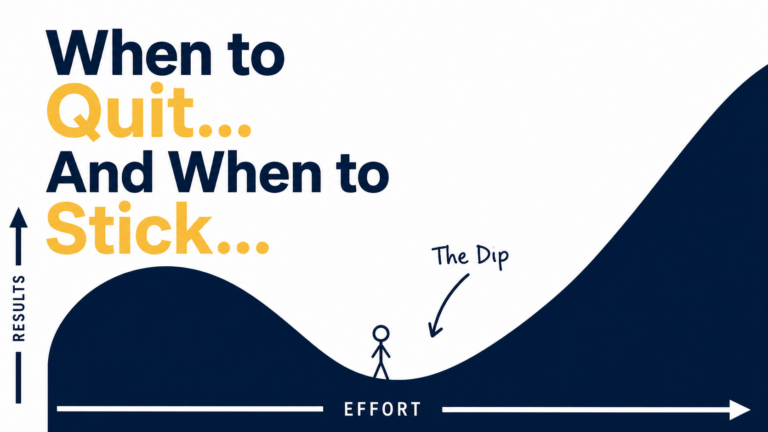
The saying “winners never quit” offers misguided counsel. Winning demands knowing when to quit strategically on pursuits that fail to deliver targeted outcomes while persisting relentlessly toward becoming the best in the world at what matters most. The central challenge lies in distinguishing moments that call for quitting from those requiring persistence.
This framework, drawn from Seth Godin’s book The Dip, provides a foundation for making that decision through lifestyle design and intention, transforming setbacks into stepping stones for personal development.
Watch This Before Reading Further
This five-minute summary captures the core concept from Seth Godin’s book.
The Dip
The Dip is ubiquitous. You are not alone in experiencing it. The phenomenon appears in countless forms: the garage band playing to an empty room, the infamous Decca Records rejection of The Beatles, the seventh fall while learning to snowboard, or Tony Hawk’s tenth failed attempt to land The 900 on live television.
The Dip shows itself in the fifth job interview that yields no callback, the 1,000th failed experiment in building the light bulb, and the fights between spouses that spiral beyond control. Steven Pressfield calls it “the resistance” in The War of Art. Geoffrey Moore calls it “the chasm.” Seneca named it “the obstacle.” Dunning and Kruger label it “the valley of despair.”
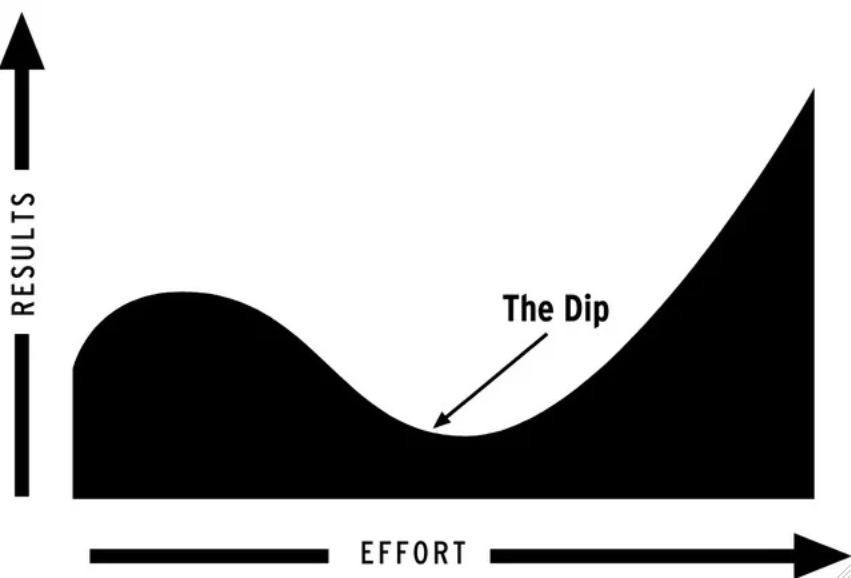
Each name points to the same experience: that difficult stretch between starting something and achieving mastery.
Why Dips Matter
Dips prove difficult for three reasons:
- They cause pain
- They are hard to identify
- The decision to stay or leave presents genuine complexity
The pain requires no explanation, yet an upside exists. Dips create scarcity, and scarcity creates value. They function as moats, separating average choices from exceptional ones.
Resources remain limited. We lack the time and money to try every available option, nor do we wish to. We seek the best products, the best experiences, and the best professionals within our means. The dip eliminates poor performers because most people quit upon encountering difficulty. Those who persevere through the dip earn a shot at being the best in the world—and the best in the world win at extraordinary levels.
The Map
Three curves define the trajectories of our pursuits: the Dip, the Cul-De-Sac, and the Cliff.
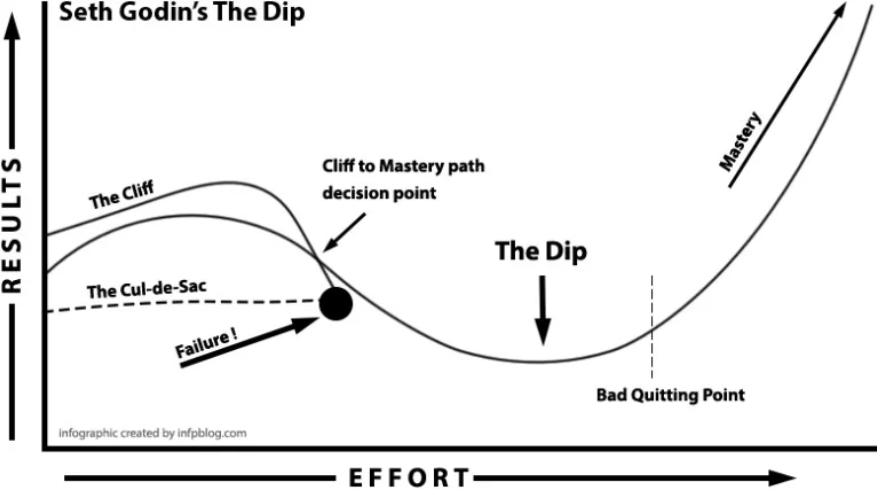
The cul-de-sac represents a dead end—a situation where effort produces no meaningful change. Things neither improve significantly nor deteriorate. Seth advises getting off this trajectory quickly, stating that the opportunity cost of investing your life in something that won’t improve remains too high. Knowing when to quit a cul-de-sac saves years of wasted effort.
The cliff describes a scenario where you cannot or will not quit until everything collapses. This pattern emerges from addiction or willful blindness regarding business, relationships, or health. At the bottom of the cliff, resources are depleted, options have vanished, and only reinvention remains.
Signs You May be in a Dip
The journey toward any meaningful destination rarely follows a smooth path.
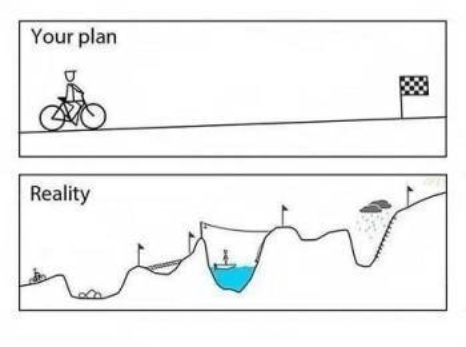
Reality presents messiness. As you pursue anything significant, you will find yourself in the dip—that extended stretch between beginner’s luck and genuine accomplishment, the long slog between starting and mastery. Meaningful pursuits begin with excitement: a bold vision, a sense of possibility, hope for transformation. Early success validates your new identity and confirms your direction.
The plot twist arrives without warning. What came easily becomes challenging. Rejections accumulate, product launches fail, relationships grow strained, or an unexpected diagnosis arrives. You feel the descent as progress per unit of effort diminishes. Doubt creeps in about the path forward. You weigh options and think of quitting, wondering about proximity to a breakthrough. This signals you may be in the dip, and knowing when to quit becomes your central concern.
Diagnosing the Dip
The definitions of these curves appear clear in theory, yet recognizing them from within your circumstances proves challenging. Three elements, when understood, diagnose your situation and point toward appropriate action.
- First, examine your mission and your commitment to it.
- Second, assess your psychological state—distinguish between fear and strategic discomfort.
- Third, evaluate the trajectory of your endeavor and its relationship to your larger purpose. These elements combine to answer crucial concerns: Am I in a dip? Does this dip deserve my persistence? Do I possess the courage to act on my conclusion?
This diagnostic approach supports intentional personal development and prevents reactive decision-making based on temporary discomfort.
Your Mission
Begin by asking yourself the true reason behind your pursuit. The first answer may not satisfy. You must answer your question with a deeper inquiry: “Why do I want that?” Repeating this sequence five to seven times often reveals the authentic motivation. The reason that initiated your journey may differ from the reason that sustains you through difficulty.
Simon Sinek’s work on finding your purpose offers valuable guidance for this exploration. Lifestyle design and intention require clarity about what genuinely matters to you. Knowing when to quit depends entirely on understanding what you are quitting toward or away from.
This clarity transforms your relationship with setbacks and redirects energy toward pursuits worthy of your full commitment. You may find this short exercise helpful.
Your Psychology
Quitting decisions often emerge from reaction rather than strategy. Determine first: Am I panicking or thinking strategically? Remain vigilant, because fear frequently disguises itself as logic or strategy, offering a “rational” exit.
Examine your reasoning closely. You might be quitting because the best-case scenario no longer aligns with your mission. Alternatively, you might be quitting because current discomfort feels unbearable, and doubt about your capabilities has taken hold. These two situations demand different responses.
Fear-setting exercises help navigate these distinctions and support personal development through honest self-examination.
The Endeavor
The endeavor represents the vehicle toward your purpose—the means to an end, not the end itself. Conflating these two guarantees dissatisfaction. Your endeavor deserves evaluation across multiple dimensions: Progress, Permanence, Alignment, Reward, Feedback, and Opportunity Costs.
Consider each dimension:
- Am I making measurable progress?
- Could improved skills change my trajectory?
- Does this obstacle appear temporary or permanent?
Does this endeavor need what I can contribute? - Do disproportionate rewards exist for making it through, or are rewards limited?
- Do trusted experts confirm I am on the right path?
- Even in failure, does this vehicle move me closer to the person I want to become in five years?
Affirmative answers to most of these indicate a dip worth persisting through. Negative answers suggest a cul-de-sac requiring knowing when to quit immediately.
Prescription for the Cul-De-Sac
The optimal time to quit is before starting. Derek Sivers embodies this principle: “If it’s not an emphatic yes, then it’s a no.” This approach to lifestyle design and intention prevents countless hours of wasted effort.
Having already begun a journey that leads toward a cul-de-sac, quitting becomes the prescription. Attachment to good or even great ideas must yield to evidence demanding a pivot. The sunk cost fallacy—the irrational belief that prior investments must be recovered regardless of success probability—traps many in doomed endeavors: failing businesses, toxic relationships, or experiences that no longer serve them. (EBSCO)
Daniel Kahneman and Amos Tversky discovered that losses feel twice as painful as equivalent gains feel good. Your brain frames quitting as a loss, even when staying costs more. Ask yourself: Starting fresh today with full information, would I choose this path? A negative answer points toward immediate action. Knowing when to quit a cul-de-sac prevents years of stagnation and opens space for personal development in more fertile territory.
Prescription for the Dip
Having determined you are in a dip pursuing something worth completing, the prescription becomes straightforward.
Seth Godin explains: “Once you see that the dip is there, you have two choices. Don’t start. Or if you’re going to start, be prepared to go to the other side.” The Vince Lombardi quote finds its proper context here: “Winners never quit, and quitters never win.” This is when commitment and perseverance become virtues—not obstacles to knowing when to quit, but evidence that quitting is inappropriate.
The tactics for reaching the other side remain unique to your context and environment. The best approaches are not always obvious. Watch this clip where Seth Godin describes the complexity of the dip in one of his businesses.
In Action
The best in the world select carefully which dips deserve full contribution while remaining ruthless about everything else. They quit doing wrong things and push through right dips. Lifestyle design and intention demand this selectivity.
- Audit your endeavors by listing roles, responsibilities, projects, and commitments, then determine which curve characterizes each.
- Set north star conditions for your dips: define success in specific, measurable terms you will recognize, and establish conditions that would indicate a transition from dip to cul-de-sac, warranting exit. Without these anchors, you will renegotiate commitment each time difficulty increases.
- Quit fast or commit fully. Quit doing wrong things. Persist through the right things. Develop the courage for decisive action, because indecision serves no one. Knowing when to quit and knowing when to persist—these skills define those who achieve mastery through personal development.
In Closing
Being the best in the world remains underrated. Those who cross the chasm, navigate the messy middle, master their craft, and dominate their market segment achieve extraordinary outcomes. They create worlds that elevate human experience and receive proportionate rewards.
Each of us possesses something to contribute and a purpose worth pursuing fully. Projects, ventures, relationships, children, causes, or habits—find the pursuits where winning changes everything. Knowing when to quit the wrong things creates space for the right ones.
As Seth writes, “Go ahead, make something happen. We’re waiting!”
Additional Reading and Resources:
Books
- The Dip by Seth Godin contains additional insights worthy of exploration.
- The War of Art by Steven Pressfield serves anyone engaged in creative work.
- The Obstacle Is the Way by Ryan Holiday benefits everyone without exception.
Videos
- Peterson x Tony Robbins, a collaborative video, focuses on the principle that a strong enough purpose overcomes any obstacle.
